Google Translation

Monday, January 28, 2013

Japan - After thoughts & Tips


After thoughts

On the last night in Osaka, H & I stayed in the hotel packing up our luggage,  drinking beers, eating snacks, and watching Japanese game shows on TV.   I was not ready to put our trip to an end.  I would have loved to spend another day to wonder around window shopping, people watching, resting in a cafe, having dinner in a restaurant, and just taking everything in.  I can now understand why my Taiwanese friends visiting Japan over and over again.    

I did not expect to feel this way since this was my 3rd trip.  Perhaps it was more enjoyable because I saw Japan through H's eyes as a westerner coming to Japan for the first time: polite and reserved people, clean and orderly society,  meticulous attention to details, a relentless pursuit of aesthetics,   the refined, understated elegance in almost everything you see, and the contrasting and rebellious energy you found in pockets of the city. 

H enthusiastically said to me that he would like to come back again.  I smiled and nodded in agreement.  Yes, I'd like to come back again.  Hokkaido 北海道 is another region in Japan I would like to visit.   It probably will not be for awhile though.  I mean, there is still the Safari trip that I have been wanting to go for years, Machu Picchu has been calling my name too, and the list goes on and on........

Tips


  • Lodging: When travel to this part of Japan, Osaka and Kyoto are both popular cities to stay. If you only have limited time and want to immerse yourself in the old Japan, Kyoto without a doubt is the best option, preferably a ryokan in Gian district if you have the money to splurge for at least one night.  If you have more time and want to visit other places in the Kansai region, Osaka is an ideal base with plenty of hotel options that meet your budget. Try to find a hotel near the Umeda station as it is the major hub for both Osaka subway railway systems so you do not need to deal with transfers from Osaka Subway to JR rail system. 

  • Railway:  Japan's railway system is a great way to travel.  They are clean, frequent, and amazingly on-time.  However the system is quite complex since there are several national and private owned railway companies and each company issues its own packaged deals.   It is worth doing your homework and learning to navigate the railway system. It will also make life easier if you pick one railway company as the mean of your main transportation during your stay to simplify your trip planning.

  • Kyoto Buses: Do not  feel intimidated to take buses in Kyoto.  The subway stops are limited and taking buses is the best way to travel from one temple to another.  Grab a bus route map,  and learn to take buses like the locals. 

  • Money: Credit cards are not as commonly accepted as in the U.S. and maybe other parts of the western world.  Most temples only accept cash payment. Same goes for the day passes for subways, trains, or buses.  Be sure to exchange enough Japanese Yen. 

  • Shoes: You will, without a doubt, be walking A LOT when you visit.  Bring a pair of comfortable shoes for walking that are also easy to take on and off, since you will be doing it a lot when you visit temples and staying in ryokans. 
  • Language: English does not seem to be as commonly used at the Kansai region as in Tokyo. The English channels we saw on TV, CNN & BBC, has Japanese voice over. Many websites does not have an English version (Google translation will be a great tool when navigating these websites).  Some locals shy away when you ask simple questions in English.  It makes the travel easier if you can read Chinese characters and it is definitely useful to learn some basic Japanese phrases.  But don't let it discourage you from visiting Japan.  All the trains, subways, and buses and major tourists sights have English directions. A little patience and some hand gestures will get you very far.  


Japan - Kyoto 11.09


View Japan 11.09 in a larger map 


  • Kinkakuji Temple 金閣寺 (Golden Pavilion)
  • Ryoanji Temple 龍安寺
  • Ginkakuji Temple 銀閣寺 (Silver Pavilion)
  • Path of Philosophy哲學之道
  • Honen-in Temple 法然院
  • Nanzenji Temple 南禪寺
  • Kyoto Station 京都車站 


At 8 AM, we heard a gentle knock on our door.  It was breakfast time!  Tomako brought trays of food to our room: miso soup, tofu stew, grilled fish, tamakoyaki (Japanese omelette), tsukemono (various types of pickled vegetable and plums), nori (dried seaweed), and steamed rice.  We were still full from last night's dinner and could barely finish one third of the food in front of us. 


As I was eating the traditional Japanese breakfast and looking at the plates and trays used in the Japanese cuisine, I thought to myself, it must be hard being a Japanese housewife! Forget about the varieties of food needed to be prepared in one meal, to wash all the dishes along would take a very long time!   

After breakfast and a bath, sadly, it was time to check out.  Although a splurge, we really enjoyed our short stay at Shiraume. 


We took the Kyoto bus to the opposite side of the town and arrived at Kinkakuji 金閣寺.   The temple was packed with tourists, understandably since it was an iconic and visually stunning temple in Kyoto.  The setting made me better understand and appreciate the classical Japanese literature I read in high school.  

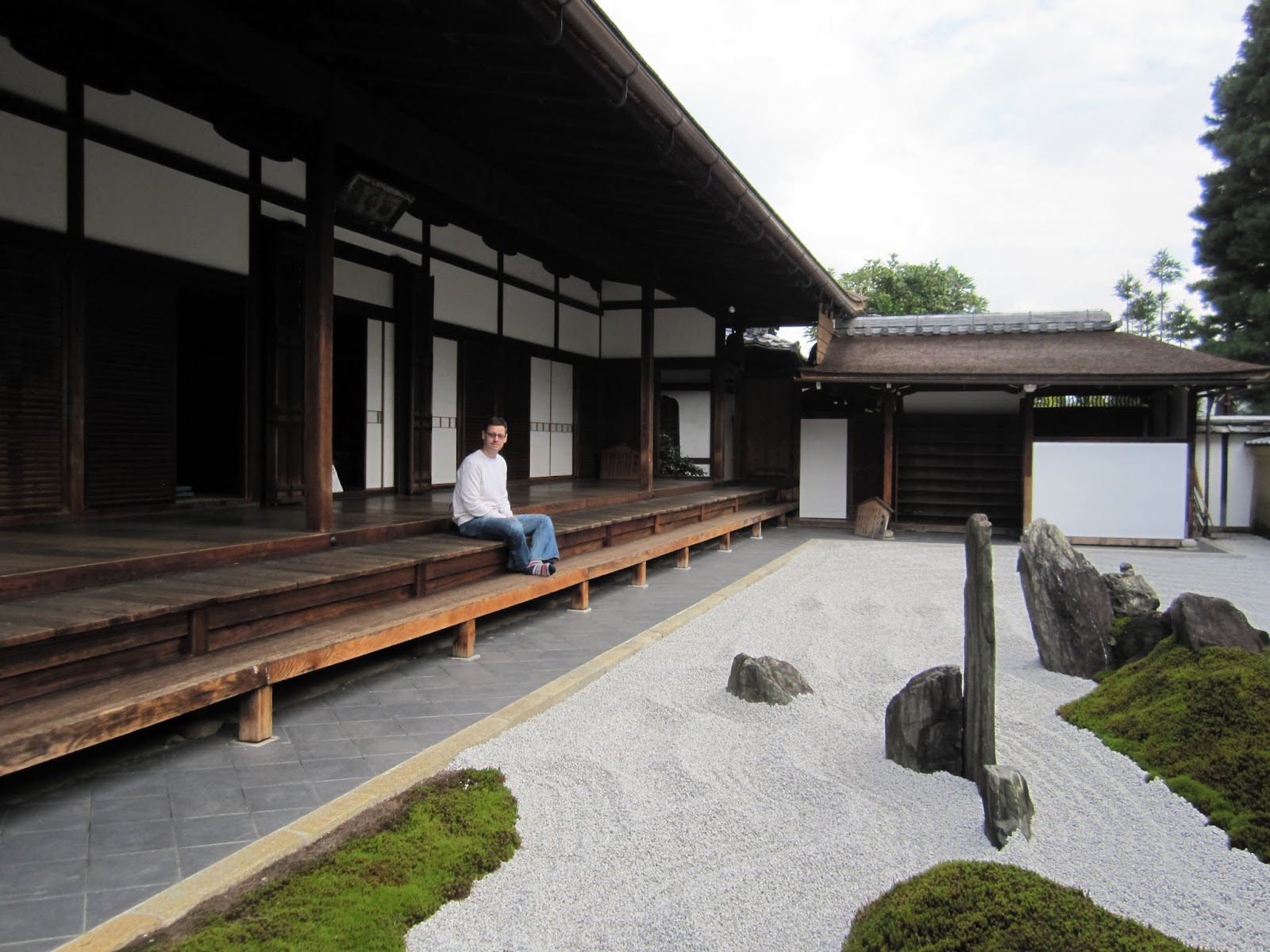
Another quick bus ride later, we escaped the mobs of crowd and came to the peaceful Ryoanji Temple 龍安寺. The temple was famous for its rock garden.   Speaking of garden, we really loved all the temple gardens we visited so far, whatever styles they might be.  H kept saying that he would get a Japanese garden just like the Oracle CEO, Larry Ellison, has  if he had the money. 

The next temple on our agenda wasGinkakuji Temple.  From Ginkakuji, we walked down the Philosopher's Path, a scenic stone path by a canal.  Along the path, we stopped by two more temples,  Honen-in Temple 法然院 and Nanzenji Temple 南禪寺.  As New Yorkers, we  were used to walk everywhere.  However, after 5 days of walking,  our legs were hurting! 


After visiting all the temples, it was time to head back to Osaka.  But before we said good-bye to Kyoto, we spent sometime inside the ultra-modern Kyoto Station,  and had ramen noodles again on the 10th floor Ramen Koji 拉麵小路.


It was down to our last night in Japan.  Maybe we were too greedy about our itinerary  or maybe there was just too much to see and too much to do in Kansai region, this trip had been exhausting! But there was still so much we want to do;  I barely had anytime to shop,  H wanted to go back to  Dotombori 道頓堀 again, and we did not eat enough Japanese food!  

After getting back to Osaka,  we stayed in Umeda shopping district and did some last minute shopping before the  department stores closed at 8 PM.   As much as we wanted to go to Dotombori for our last night's meal, H & I eventually caved into our exhaustion.  We bought a hello kitty chocolate mouse cake from the food court (it looked good and tasted even better!), some special winter beers, and snacks from the convenient store  on the way back to the Sheraton.  Once we checked into, we never made it out of our room again until the next day when we flew back to New York.  


PHOTO ALBUM


Wednesday, January 23, 2013

Japan - Kyoto 11.08


View Japan 11.08 in a larger map
  • Nijo Castle 二條城
  • TenTenYu Ramon Bar
  • Kyoto Imperial Palace 京都御所
  • Shiraume Ryokan 白梅料理旅館
  • Kiyomizu Temple 清水寺
  • Kodaiji Temple 高台寺
  • Gion 祇園  

Finally, it was time to visit Kyoto today.  H's birthday is in November.  When I was preparing for this trip, I decided to book a traditional Ryokan in Kyoto as H's birthday gift. Originally, I was planning to stay at Shiraume Ryokan for the first 2 nights of our trip.  However, with only 6 rooms in Shiraume, I was only able to secure one room for one night.  

We checked out of Sheraton and stored our luggage at the hotel since we would be returning the next day and only brought a small backpack with us to Kyoto.  The express JR train took less than 40 minutes from Osaka to Kyoto.  

Once at Kyoto station, we purchased the two day bus/subway pass for JPN 2,000.  We probably did not ride enough to make the pass worthwhile, but it definitely saved us a lot of hassle.


Our first stop was Nijo Castle.   The Ninomaru Palace had 5 huge halls with tatami floors and wall painting dividers connected by a corridor.  I kept wondering how people centuries ago kept warm in the winter in these types of architectures.   Walking on the corridor of the Palace, the wooden floor made  squeaking sounds, almost like bird chirping.  It was called a nightingale floor to alert guards when  intruders were coming in. 

After Nijo Castle,  we were starving.  Our next destination, Kyoto Imperial Palace, had free English tours at 10 AM and 2 PM.   We decided to get a quick bite before the 2 PM tour.  I was craving for Ramon and was lucky to find a small Ramon bar in Shijo.  The ramon noodle soups were delicious!


Kyoto Imperial Palace was inside the Kyoto Imperial Park. There were two subway stations at the opposite end of the park.  Imadegawa Station 今出川駅 will save you at least a 15 minutes walk and take you closest to the office of Imperial Household Agency to apply for the free tour.  After spending a lot of money on layers and layers of entrance fees the past few days, it was a pleasant change to have a free tour of the Palace.


After the palace, we were ready to check into our Ryokan.  The Shiraume Ryokan was located in the heart of the historical Gion district with the Shirakawa Stream 白川 running in front of the Inn on the picturesque Shinbashi 新橋通 street.  It was an idyllic setting in a beautiful location.  We felled in love with the inn before we even stepped a foot in it.   


Satoko, one of the inn keepers was there to help us with the check-in and decision on dinner & breakfast details.  H was thrilled with our traditional tatami room and private garden and I was happy to share the experience with him.  Eventually, I had to force H out of the room so we could visit Kiyomizu Temple 清水寺 before it closes. 

Kiyomizu-michi 清水道, the street leading to the Kiyomizu Temple, was probably more interesting than the temple itself.   Beautiful old houses and souvenir shops along side the streets.   By the time we reached the temple, the sun had set.  The view from Kiyomizu Temple overlooking Kyoto city was beautiful.  


After Kiyomizu Temple, we headed back to our Ryokan just in time for our Kaiseki Ryori 懐石料理.  There were no other guests in the dinning room that night so we had the place all to ourselves.  The Inn owner, Tomoko, was serving us that night.  She offered a pot of Kyoto sake with golden flakes for H's birthday.  The sake was light and smooth, so much better than the sakes we had in New York.  Tomoko explained that Sake is a very delicate  drink.  Often the transportation of sake affects its flavor.  The ten course Kaiseki Ryori meal was too exquisite to be eaten.  Although every course came in small portions, we were quite full by the end of the dinner.  Tomoko was a gracious hostess and great conservationist.  Every time she brought the dishes to the dinning room, we would chat about the food, the Inn history and Kyoto.  Tomoko told us that Shiraume was originally an Oyagi teahouse in Edo period and she was the 7th generation owner, and that this type of business was only passed down to the women in the family.  Although there were other guests in the inn having dinner at their rooms, Tomoko gave us undivided attention, and the service was never rushed.


Two hours later, we finished dinner and headed out again to Kodaiji Temple 高台寺 as per Tomoko's recommendation.  During the autumn season in Kyoto, many temples and shrines host evening illuminations of the fall leaves in displays.  Kodaiji Temple is well-known for it. When the light lid up the garden, the reflection of the maple leaves on the temple's pond was absolutely breathtaking.  We reluctantly left the temple after the temple staff politely informed us of it's closing time. 


Walking back towards our ryokan,  we strolled through the cobbled street of Hanami-Koji 花見小路通.  The street was lined with traditional old wooden houses that operated as restaurants on both sides.  We saw Japanese men in business suites accompanied by a geiko (Geisha in Kyoto region) or a maiko (apprentice geiko) coming out of the restaurants.  Old fashioned taxies were waiting by the street as the restaurant hostesses and chefs came out bowing good-bye in a 90 degree angle.   The setting was so dreamy that H and I felt that we were transported back in time to the Edo era.  


It had been an amazing day with highlights after highlights.  Both H & I were exhausted, and we returned to our ryokan just before the mid-night curfew. 


PHOTO ALBUM